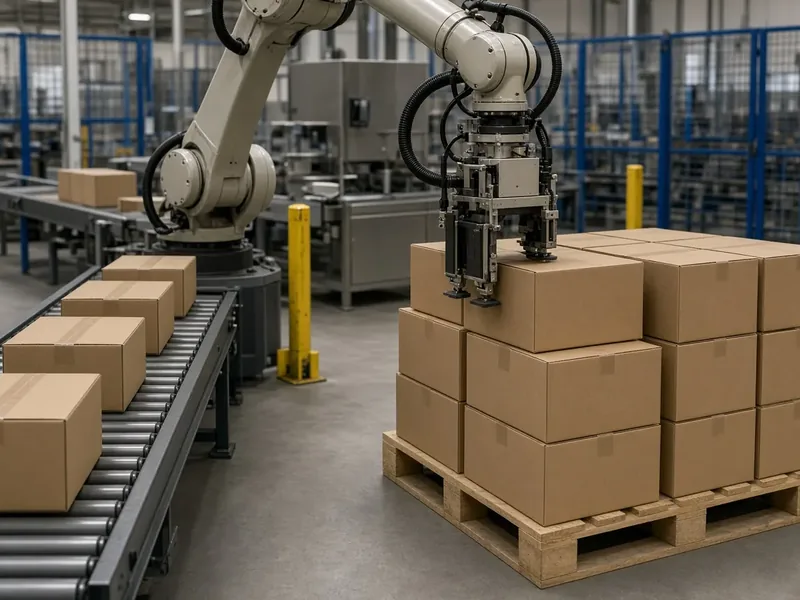
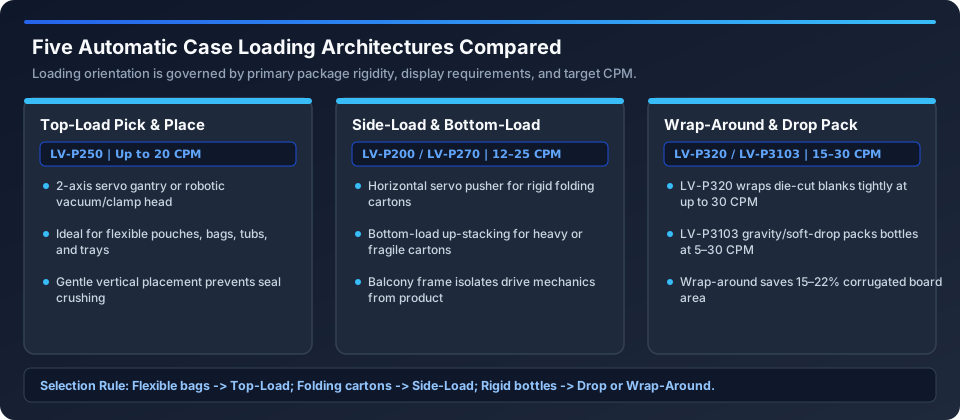
Comparing a robotic case packer (LV-RD120 / LV-RP200) against a dedicated mechanical servo case packer (LV-P250 / LV-P200 / LV-P320) weighs multi-SKU orientation flexibility and 5-minute EOAT recipe switches against higher single-format CPM per dollar of capital investment.
Robotic Kinematics (4-Axis Delta vs 6-Axis Articulated) & Monoblock Integration
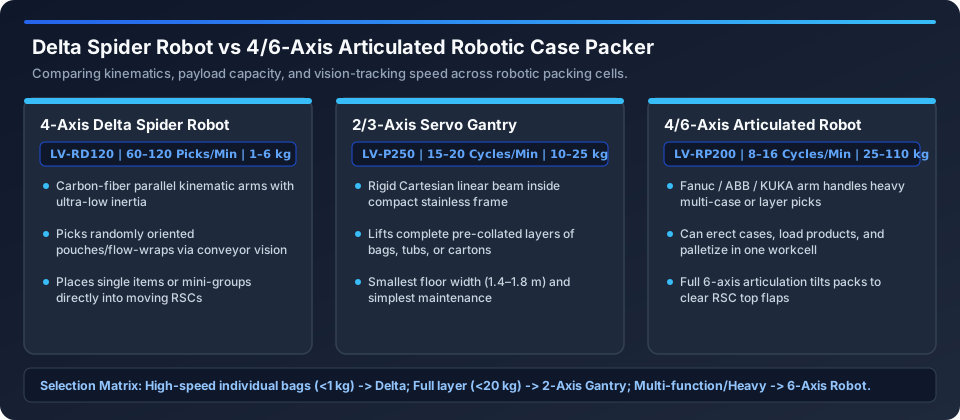
Robotic case packing cells (LV-RD120 and LV-RP200) and single-frame monoblocks (LV-P200-MP) replace fixed mechanical linkages with programmable servo paths—allowing one cell to orient, collate, load, and even palletize multiple SKUs inside a compact footprint. Model your floor space in our secondary packaging line footprint planner and apply three kinematic rules:
- 4-Axis Parallel Delta (
LV-RD120,60–120 picks/min) vs 6-Axis Articulated Arm (LV-RP200,8–16 cycles/min): High-speed flexible flow-wraps, pouches, and thermoformed trays under3.0 kgarriving in random orientation on a belt require a carbon-fiber 4-axis Delta spider robot guided by aKeyence/Cognex2D conveyor-tracking camera. Heavy full-layer payloads (10–50 kg), jugs, or cells that alternate between case loading and palletizing require a 4/6-axis articulated robot arm (LV-RP200). - 40% Floor Footprint Reduction with Monoblock Integration (
LV-P200-MP): A conventional inline secondary line (separate case erector + conveyor + case packer + conveyor + sealer + accumulation + palletizer) consumes14 to 18 metersof length (~52 m²). Combining case erecting, loading, sealing, and robotic palletizing into one common-chassis monoblock (LV-P200-MP) shrinks the cell to6.5 to 8.5 meters(~30 m²,-40%floor area) under one PLC and safety circuit. - 5-to-10 Minute Tool-Less Recipe & EOAT Changeover: Because pitch spacing, layer rotation (
90° / 180°), and drop depth are stored inAllen-BradleyorSiemensrobot recipes, operators switch SKUs on the touchscreen HMI and snap on quick-release pneumatic EOAT plates in5 to 10 minutes.
Compare related configurations and sizing tools across automatic case packers, robotic case packing systems, case packer speed and collation calculator, wrap-around vs RSC corrugated cost calculator, case packer cost and ROI calculator, case packer FAT checklist and jam troubleshooting manual.
End-of-Arm Tooling (EOAT), Vision Tracking & Safety Interlocks
Even the fastest servo collator will miss shift OEE targets if the case erecting, flap sealing, or downstream accumulation module jams on high-recycle corrugated board. LINEVO enforces four mechanical design standards across every station:
| Robotic Cell Architecture | LINEVO Series | Rated Speed & Payload | Vision & Collation Method | Ideal Plant Application |
|---|---|---|---|---|
| 4-Axis Delta Vision Cell | LV-RD120 |
60–120 picks/min (≤3 kg pick) |
2D camera conveyor tracking + encoder belt | Randomly oriented pouches, flow-wraps, bakery & frozen trays (12–25 CPM) |
| 6-Axis Articulated Packer | LV-RP200 |
8–16 cycles/min (25–65 kg layer) |
Servo race-track or lane collator + full-layer EOAT | Heavy multipacks, jugs, cans, and multi-SKU contract packaging (10–22 CPM) |
| Cobot Dual-Role Packer | LV-CP12 |
6–10 cycles/min (12–25 kg payload) |
Fenceless dual-zone floor laser scanner (ISO/TS 15066) |
Low-to-medium speed lines (4–10 CPM) with tight aisle clearance |
| Monoblock Packer-Palletizer | LV-P200-MP |
8–16 CPM (-40% floor footprint) |
Integrated Erect + Pack + Seal + Palletize in one frame | Brownfield plants automating case packing and palletizing in <8.5 m length |
4-Gate Factory Acceptance Testing (FAT) & Turnkey Line Qualification
Before any LINEVO case packer, case erector, or integrated monoblock (LV-P200-MP) is approved for crating, our engineering team executes a documented 4-Gate Factory Acceptance Test (FAT) using 30 to 50 of your actual knocked-down corrugated blanks and production product samples:
- Gate 1 — 30-Minute Uninterrupted Run at 100% Rated CPM: The machine packs
300 to 900 consecutive casesat full contract speed with≥98.5%net completion, zero vacuum-drop misfires, and≥80%hot-melt fiber tear across all four major flaps. - Gate 2 — Timed ≤15-Minute No-Tool SKU Changeover: A single technician switches the machine from your smallest SKU to your largest SKU using only the Siko digital counter recipe sheet and quick-release pin mandrels, verifying first-case diagonal squareness within
±1.5 mm. - Gate 3 — PackML Upstream & Downstream Handshake Simulation: Full verification of dry-contact or Ethernet/IP / Profinet interlocks with upstream checkweighers, metal detectors, downstream
LV-9560PLprint-and-apply GS1-128 labelers, and24VMDR accumulation conveyors.
To get a formal cycle-rate calculation, CAD floor layout, and itemized engineering quotation for your package and box drawing, message our LINEVO engineering team directly on WhatsApp.
Get a Case Packing Route Checked Against Your Box Samples
Send your primary package dimensions, pack pattern (R × C × L) and target CPM on WhatsApp. LINEVO engineers will propose a case packing layout and the FAT checks to run on your corrugated blanks.
Compare robotic vs mechanical for my line